


Week of May 26, 2026

Published every Monday: Get a detailed snapshot of what moved the markets last week—and what to watch this week.

What is the Federal Reserve (Fed) likely to do next?

U.S. markets rallied as oil prices declined 8 percent amid hopes for a settlement to end the war in the Middle East. The Dow Jones Industrial Average and the Russell 2000 Index each rose more than 2 percent. Yields on the 10-year Treasury bond moved marginally lower, closing at 4.56 percent.

Weekly Quick Hits

Beyond the Headlines

What is the Federal Reserve (Fed) likely to do next?

Report Releases

Minutes from the Fed’s April meeting showed division on interest rate policy.

Financial Market Data

Stocks rallied across the board; the Dow Jones and the Russell 2000 each rose more than 2 percent.

Looking Ahead

Consumer confidence and spending take center stage this week.

BEYOND THE HEADLINES:

What is the Fed likely to do next?

When setting interest rate policy, the Fed follows its dual mandate: maximum employment and stable prices. Those metrics are moving in opposite directions. Job creation, though not robust, has been positive after several negative months. Conversely, inflation has accelerated because of tariffs and surging oil prices.

This divergence has led to division among Federal Open Market Committee (FOMC) members. There is now a small chance that the central bank will raise rates before the end of the year. The real questions facing investors are: what would cause that to happen, and what would it mean for portfolios?

Status Quo—for Now
The FOMC, which has eight meetings each year, next gathers in mid-June and late July. It’s unlikely the Fed will act on interest rates this summer. With the economy continuing to expand—thanks to the magnitude of the artificial intelligence infrastructure build-out and growing employment—the central bank doesn’t need to stimulate the economy. This gives the Fed the ability to remain data-dependent and wait to see how inflation unfolds and how that affects hiring and growth.

Inflation Is the Key
The path of accelerating inflation hinges on the Strait of Hormuz. With a potential agreement to end the war and open the strait—which would return much-needed oil supply to the global economy—inflation could trend lower through the end of the year. It’s hard to envision the Fed raising rates if it believed inflation would move closer to its 2 percent target.

With any settlement, however, the details are critical. There are two key questions:

  • Will the strait reopen completely, without restrictions?
  • How long will it take to return to shipping levels from January and February?

The answers will determine whether the increase in inflation is temporary or whether it will have a lasting effect on consumer spending and the economy.

What Does It Mean for Portfolios?
The most likely path for Fed interest rate policy is a slow, cautious move lower over the next couple of years. But this depends heavily on inflation. In other words, small cuts are possible, but patience remains the dominant theme for policy changes.

Although interest rates are unlikely to return to levels seen after the 2008 financial crisis and the Covid-19 pandemic, it isn’t necessarily bad news for investors. For savers and retirees, cash yields remain attractive and won’t drop quickly. Historically, stocks have benefited from stable or slightly lower rates. For bond investors, gradual cuts should provide a tailwind but still allow for opportunities to add attractive intermediate-term yields to portfolios.

In other words, the current environment should be supportive over the long term for markets.


“The most likely path for Fed interest rate policy is a slow, cautious move lower over the next couple of years. But this depends heavily on inflation. 

Report Releases: May 18–22, 2026

National Association of Home Builders Housing Market Index:
May (Monday)

Home builder sentiment improved modestly after falling sharply in April. Despite the improvement, the index remained in contractionary territory.

  • Expected/prior month sentiment: 34/34
  • Actual month sentiment: 37

FOMC Meeting Minutes:
April (Wednesday)

Minutes from the April FOMC meeting suggested a divided central bank. In the post-meeting statement, some members advocated removing language that indicated an easing bias, while others successfully pushed to keep it.

Housing Starts and Building Permits:
April (Thursday)

These two measures of new home construction were mixed in April. Housing starts fell after surging in March, while building permits rebounded following a steep decline the previous month.

  • Expected housing starts/prior housing starts: –5.3%/+12.0%
  • Actual housing starts: –2.8%
  • Expected building permits/prior building permits: 2.5%/–11.5%
  • Actual building permits: +5.8%


The Takeaway


  • Housing market updates remained mixed.
  • FOMC meeting minutes showed that the Fed is divided on the path forward for interest rates due to the recent surge in oil prices and accelerating inflation.

Financial Market Data

Equity

U.S. markets were higher, but leadership shifted. The Dow Jones and Russell 2000 each rose more than 2 percent, and the Nasdaq Composite and S&P 500 were each up nearly 1 percent. The catalyst was an 8 percent drop in oil prices because of favorable headlines about a potential deal to end the Middle East war. Health care, utilities, and real estate each rose more than 3 percent. Communication services and consumer staples lagged. International equities also rallied; developed markets rose more than 3 percent.
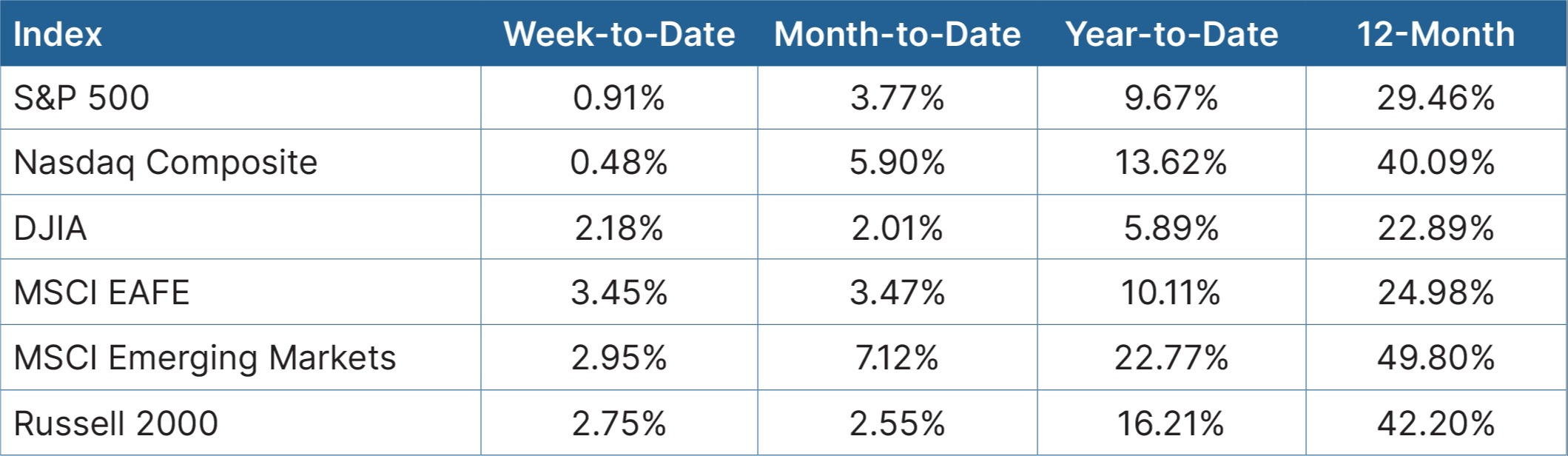
equity graph

Source: Bloomberg, as of May 22, 2026

Fixed Income

Fixed income markets were mostly higher. Continued commentary regarding a potential deal to end the war in the Middle East calmed markets. The yield on the 10-year Treasury halted its steep rise, closing at 4.56 percent. This closing yield was down 4 basis points (bps) compared with the previous week. High-yield bonds also moved higher, while the municipal market was flat.
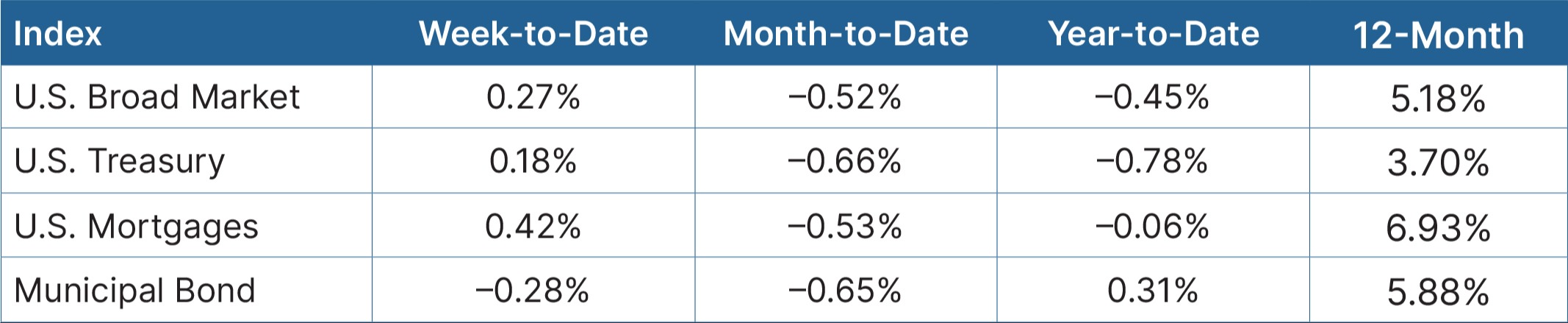
Fixed Income Graph

Source: Bloomberg, as of May 22, 2026

The Takeaway


  • Stocks, led by the Dow Jones and the Russell 2000, continued higher. Health care, utilities, and real estate each rose more than 3 percent.
  • Fixed income markets were mostly higher. Commentary about a potential deal in the Middle East led Treasury yields to move lower.
Looking Ahead Image

Looking Ahead

Consumers will be the focus of economic reports this week. The Conference Board Consumer Confidence Index and personal income and spending data will give investors insight into how consumers are navigating higher energy prices.

  • The week kicks off on Tuesday with the Conference Board Consumer Confidence Index for May. It’s expected that confidence will fall after improving modestly in April.
  • On Wednesday, we’ll see a report on personal income and spending for April. Both are expected to increase, with personal income rebounding after falling in March.
  • Earnings reports continue; highlights include Costco and Dell.

Disclosure: This material is intended for informational/educational purposes only and should not be construed as investment advice, a solicitation, or a recommendation to buy or sell any security or investment product. Diversification does not assure a profit or protect against loss in declining markets, and diversification cannot guarantee that any objective or goal will be achieved. Please contact your financial professional for more information specific to your situation.

Bonds are subject to availability and market conditions; some have call features that may affect income. Bond prices and yields are inversely related: when the price goes up, the yield goes down, and vice versa. Market risk is a consideration if sold or redeemed prior to maturity.

Certain sections of this commentary contain forward-looking statements that are based on our reasonable expectations, estimates, projections, and assumptions. Forward-looking statements are not guarantees of future performance and involve certain risks and uncertainties, which are difficult to predict. All indices are unmanaged and are not available for direct investment by the public. Past performance is not indicative of future results. The S&P 500 is based on the average performance of the 500 industrial stocks monitored by Standard & Poor’s. The Nasdaq Composite Index measures the performance of all issues listed in the Nasdaq Stock Market, except for rights, warrants, units, and convertible debentures. The Dow Jones Industrial Average is computed by summing the prices of the stocks of 30 large companies and then dividing that total by an adjusted value, one which has been adjusted over the years to account for the effects of stock splits on the prices of the 30 companies. Dividends are reinvested to reflect the actual performance of the underlying securities. The MSCI EAFE Index is a float-adjusted market capitalization index designed to measure developed market equity performance, excluding the U.S. and Canada. The MSCI Emerging Markets Index is a market capitalization-weighted index composed of companies representative of the market structure of 26 emerging market countries in Europe, Latin America, and the Pacific Basin. The Russell 2000® Index measures the performance of the 2,000 smallest companies in the Russell 3000® Index. The Bloomberg US Aggregate Bond Index is an unmanaged market value-weighted performance benchmark for investment-grade fixed-rate debt issues, including government, corporate, asset-backed, and mortgage-backed securities with maturities of at least one year. The U.S. Treasury Index is based on the auctions of U.S. Treasury bills, or on the U.S. Treasury’s daily yield curve. The Bloomberg US Mortgage Backed Securities (MBS) Index is an unmanaged market value-weighted index of 15- and 30-year fixed-rate securities backed by mortgage pools of the Government National Mortgage Association (GNMA), Federal National Mortgage Association (Fannie Mae), and the Federal Home Loan Mortgage Corporation (FHLMC), and balloon mortgages with fixed-rate coupons. The Bloomberg US Municipal Index includes investment-grade, tax-exempt, and fixed-rate bonds with long-term maturities (greater than 2 years) selected from issues larger than $50 million. One basis point is equal to 1/100th of 1 percent, or 0.01 percent.

Authored by the Investment Research team at Commonwealth Financial Network®.

© 2026 Commonwealth Financial Network®

Let’s Talk About Your Financial Future

Whether you’re navigating a volatile market or preparing for the future, we’re here to help.

Schedule a Consultation